
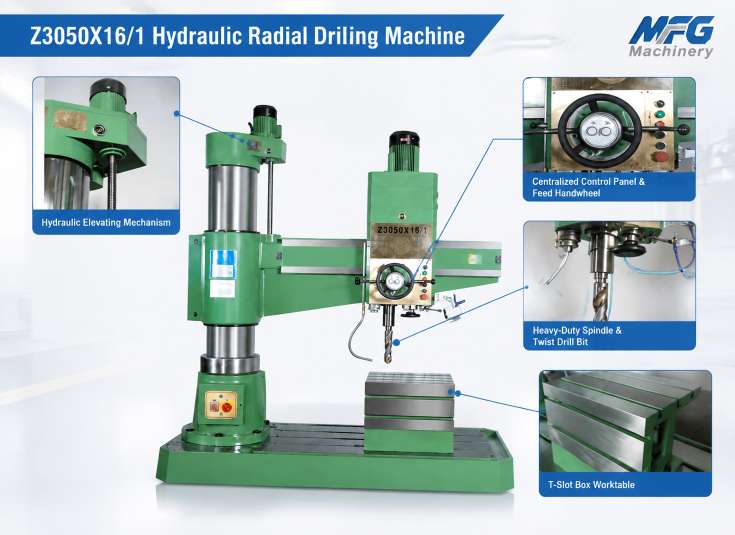
If your radial drill wanders off center or snaps large drill bits, the machine is likely flexing under the cutting torque. Manual mechanical clamps simply cannot grip the column tight enough for heavy drilling. Upgrading to a hydraulic clamping system locks the column, arm, and spindle head together instantly, turning the machine into a single, immovable block of cast iron.
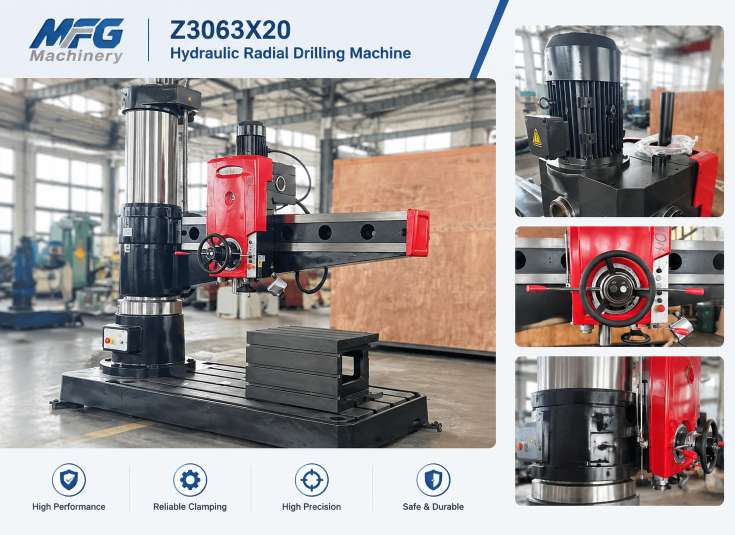
The Invisible Movement Ruining Your Parts
When a heavy-duty drill bit (like a 50mm or 63mm) bites into a solid steel block, the rotational force is massive. The drill wants to twist the workpiece, and the steel pushes back against the machine.
If the locking mechanism on the machine is weak, this push-back causes the spindle head to shift slightly along the arm, or the entire arm to rotate a fraction of a millimeter on the column. Operators call this "drill wandering." By the time you notice the shift, the hole is out of tolerance, or the sideways pressure has shattered your expensive cutting tool.
Mechanical Clamping: The Limit of Hand Power
Light-duty machines use mechanical clamping. The operator pulls a heavy lever, which turns an internal cam to tighten a split ring around the column.
This works fine for drilling small holes in thin plates. However, human arm strength combined with a simple mechanical lever cannot generate enough locking force to resist the extreme torque of a 50mm drill. Over time, the mechanical cams wear down, the grip loosens, and the arm begins to slide during deep cuts.
Hydraulic Clamping: The "Solid Block" Solution
To fix this, heavy-duty machines like the radial drilling machine use multi-point hydraulic clamping.
With the push of a button, a motorized pump drives high-pressure oil into clamping cylinders. These cylinders simultaneously lock the inner and outer columns, secure the arm to the column, and grip the spindle head to the arm's guideways. The clamping pressure is consistent, extreme, and unaffected by operator fatigue. The entire machine structure acts as one solid block of iron, guaranteeing that the drill travels perfectly straight downward.
Market Insight: The Cost of Under-Clamping
Many repair shops try to save capital by buying a large radial drill with manual mechanical locks. They soon find that they have to significantly reduce their feed rates to prevent the arm from shifting. What they saved on the purchase price is quickly lost in longer cycle times, broken taps, and scrapped workpieces. For holes larger than 40mm, hydraulic clamping is not an optional luxury—it is a mandatory requirement for shop-floor safety and part accuracy.
Quick Clamping Comparison
If you are comparing machine specs, here is what to expect from the locking systems when pushed to the limit:
| Machine Action | Mechanical Clamping | Hydraulic Clamping |
|---|---|---|
| Locking Force | Limited by operator physical strength | Consistent, high-pressure hydraulic force |
| Activation | Slow, requires pulling multiple manual levers | Instant, synchronized push-button lock |
| Heavy Drilling (50mm+) | Arm may shift or vibrate under heavy load | Machine remains perfectly rigid |
| Wear and Tear | Cams and levers loosen over time | Self-adjusting hydraulic pressure |
Stop Breaking Tools on Heavy Jobs
Are you struggling to keep holes straight on large steel castings or structural beams? Send us the details of your toughest drilling jobs, including the maximum hole size and material type. We will help you spec a radial drill with the exact clamping power you need to stop wasting time and tooling.
- Email: info@mfg-machinery.com
- Tell/WA: +86 175 2133 1995