
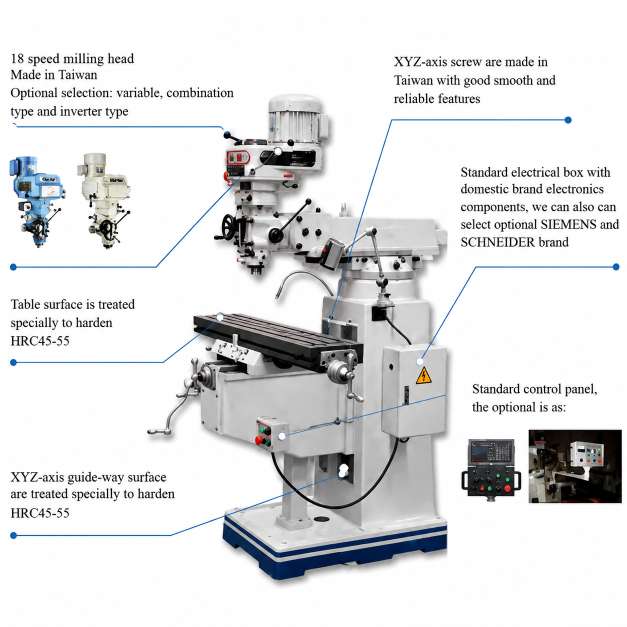
When buying a turret milling machine (knee mill) for your shop, comparing only motor power and table dimensions is a mistake. The real difference between a mill that holds tight tolerances for ten years and one that vibrates, loses accuracy, and breaks down in six months lies in the hardware details. This guide breaks down the four core components—milling head speed control, guideway hardness, lead screw backlash, and electrical brands—to help you avoid the traps of cheap machinery.
1. The Milling Head: Step Pulley vs. Inverter Variable Speed
The spindle is the heart of the mill. Most heads on the market are either traditional 18-speed step pulleys or inverter-driven variable speed heads. Many high-quality heads manufactured in Taiwan offer excellent precision and quiet operation.
- Step Pulley Head: Mechanically simple, maintenance-free, and delivers high torque at low speeds. The downside is that operators must stop the spindle, open the housing, and manually move the belts to change RPM. If your shop runs large batches of the same material, this is the most cost-effective choice.
- Inverter Variable Speed Head: Allows operators to adjust spindle RPM in real-time by simply turning a dial. If you run a custom job shop where you might machine soft aluminum in the morning and tough alloy steel in the afternoon, the time saved by instant speed adjustments will quickly pay for the upgrade.
2. Table and Guideways: Why HRC45-55 Hardening is Non-Negotiable
Shop floors are tough environments. Heavy cast iron vises get dropped on the table, and abrasive steel chips mix into the way oil.
If a machine uses unhardened cast iron, the guideways in the center of the table travel will wear down much faster than the ends. This causes "table sagging," where your milled surface ends up high in the middle and low on the ends. High-quality knee mills induction-harden their table surfaces and X/Y/Z guideways to HRC45-55. This hardened layer acts as armor against impact damage and abrasive wear, ensuring the three axes remain perfectly square and straight after years of heavy cutting.
3. Drive and Lead Screws: Eliminating Backlash Disasters
Operators running cheap manual mills often fight massive "backlash"—turning the handwheel a half-revolution before the table actually starts moving. This slop between the lead screw and the nut makes precision hole positioning nearly impossible. Worse, during a heavy climb milling pass, excessive backlash allows the cutter to suddenly pull the table forward, snapping the end mill or scrapping the part.
Premium knee mills are equipped with high-precision lead screws or ball screws (often manufactured in Taiwan). Precision thread grinding and high-quality nuts keep initial backlash to an absolute minimum. This gives the operator a smooth, buttery feel on the handwheels with predictable resistance, drastically reducing manual machining errors.
4. Electrical Systems: Do Not Let a $10 Contactor Ruin Your Week
The electrical box is the nervous system of the machine tool. Many buyers accept generic, off-brand electrical components to keep the purchase price low. The nightmare begins when a cheap contactor or relay burns out in a hot shop environment. Because these obscure parts are rarely stocked by local hardware suppliers, the machine sits idle for a week waiting for overseas shipping.
If your machine is operating in a heavy-duty production environment or being exported to a remote location, specify standard international electrical brands like Schneider or Siemens. This is not just about component lifespan; it is about global availability. If a relay fails, your maintenance tech can drive to any local electrical supply house, buy the exact replacement, and have the machine running again the same day.
Quick Buyer's Checklist
Use this configuration matrix to match the machine specs to your shop's primary workload:
| Shop Type / Core Need | Recommended Milling Head | Guideways & Screws | Electrical System |
|---|---|---|---|
| General Repair & Maintenance | Inverter Variable Speed (versatility) | HRC45-55 ways + standard screws | Siemens or Schneider |
| Single-Part Production Runs | 18-Speed Step Pulley (cost-effective) | Hardened ways + Taiwan lead screws | Standard domestic brands |
| Precision Mold & Custom Tooling | Inverter Variable Speed (fast response) | Must have precision Taiwan ball screws | Siemens or Schneider |
Get Your Custom Mill Configuration
Whether you are replacing an aging machine or outfitting a new toolroom, send us your typical workpiece materials, required tolerances, and budget. MFG Machinery will help you match the exact frame rigidity and drive configuration to your daily shop needs.
- Email: info@mfg-machinery.com
- Tell/WA: +86 175 2133 1995