
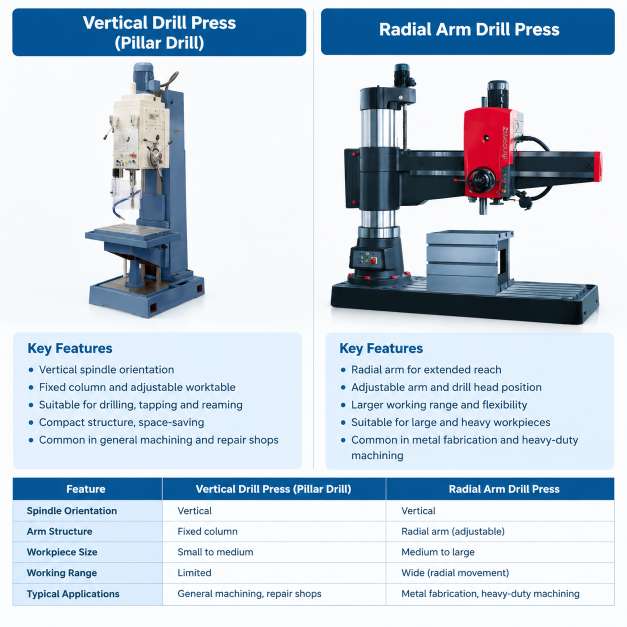
Choosing the right drilling machine for your workshop or manufacturing plant can make a huge difference in productivity, efficiency, and machining accuracy. Two of the most common heavy-duty drilling machines are the Vertical drill Press (often called pillar drill or Vertical drill) and the Radial Arm Drill Press.
At a glance, the core difference comes down to movement:
Vertical Drill: The spindle position is fixed, meaning you have to move and align the workpiece to the drill bit.
Radial Arm Drill: The workpiece stays completely still. Instead, you move the heavy-duty radial arm and spindle box to locate and drill holes across a large area.
Comparison Table
| Feature | Vertical Drill Press (Pillar Drill) | Radial Arm Drill Press |
|---|---|---|
| Machine Pictures | 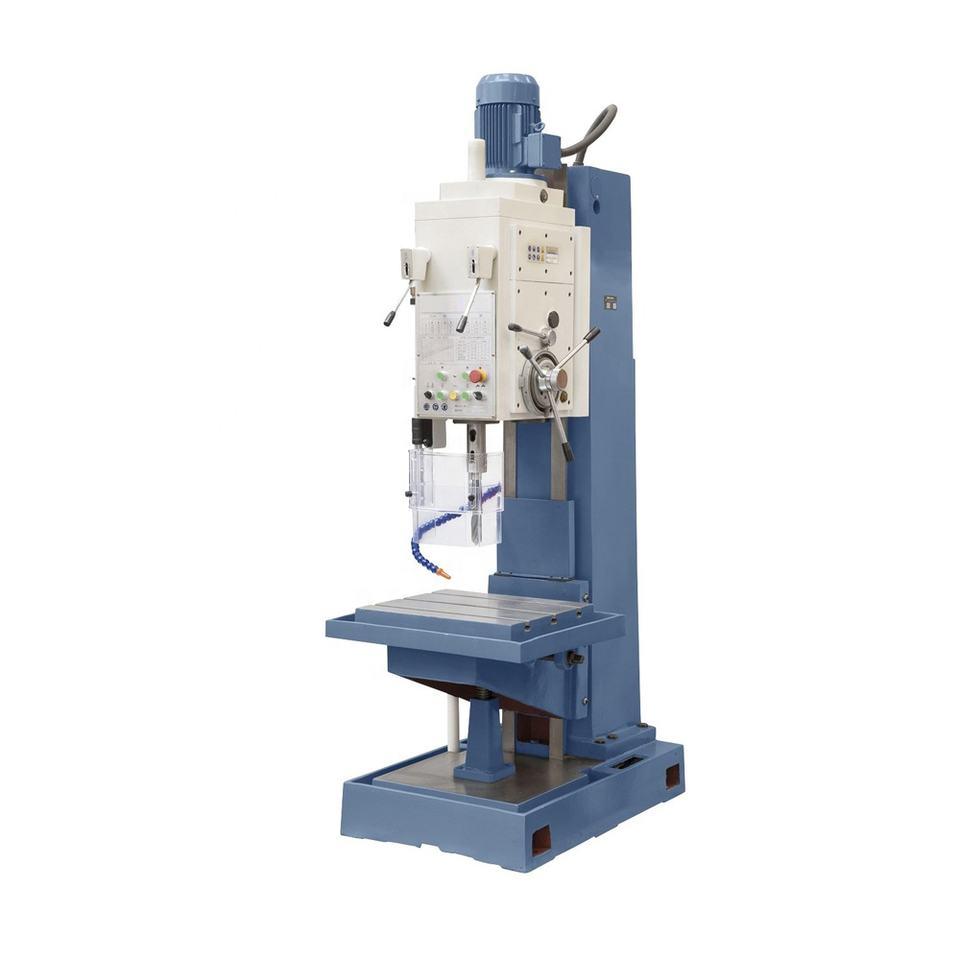 |
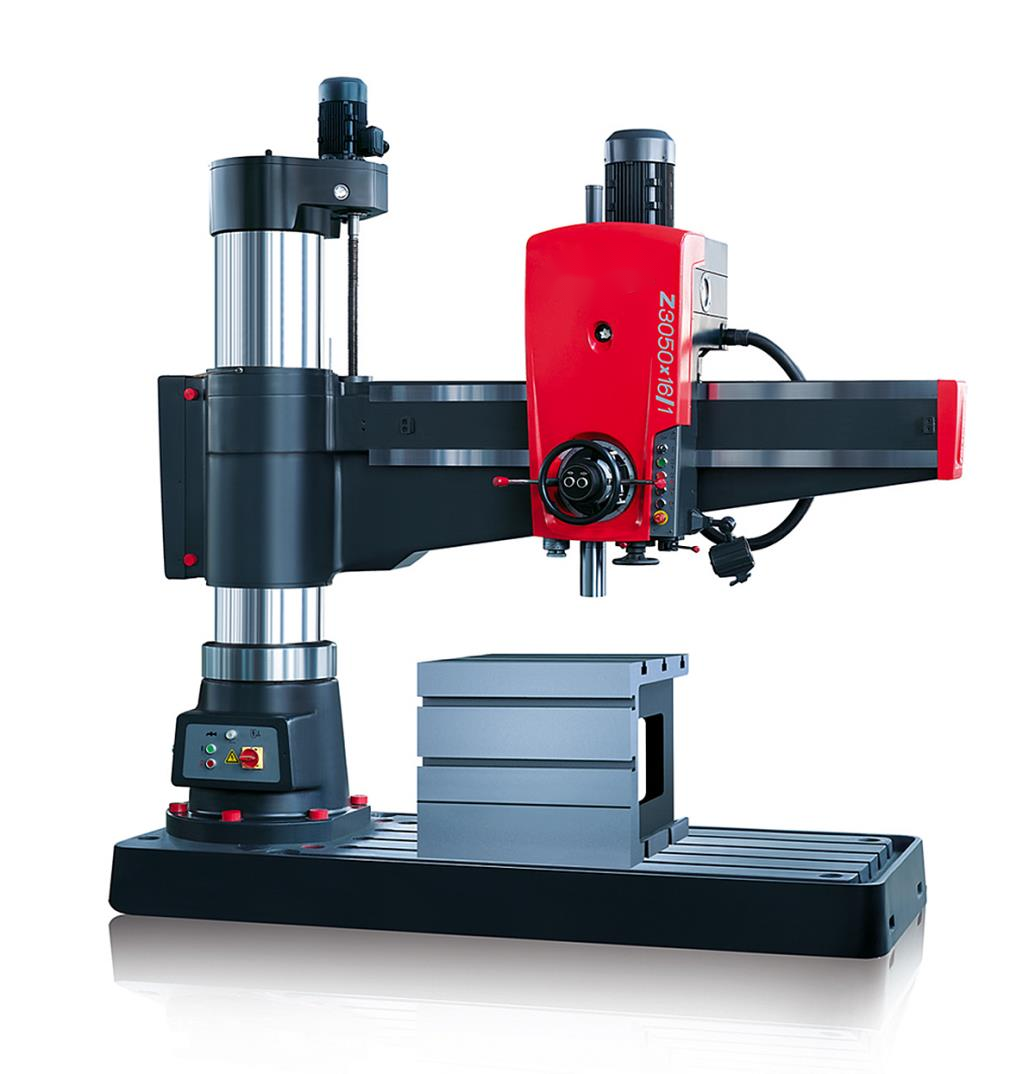 |
| Core Movement | Fixed spindle; movable worktable | Movable radial arm & swiveling spindle head |
| Workpiece Handling | Workpiece moves to align with the drill bit | Workpiece remains stationary on the base/floor |
| Best Suited For | Small-to-medium parts, concentrated holes | Large, heavy workpieces, bulky frames, multiple scattered holes |
| Rigidity & Accuracy | High rigidity, excellent repeat positioning accuracy | Lower rigidity at arm extension, suitable for heavy-duty roughing |
| Machine Footprint | Compact, saves workshop floor space | Large footprint, requires more clearance |
| Common Series | Z51 Series | Z30 Series (e.g., Z3050) |
1. Structural Design
Vertical drill Press (e.g., Z51 Series)
Design: The spindle box is securely mounted to a solid vertical column. The spindle can only move vertically (up and down) for feeding, with zero horizontal movement.
Table Movement: The worktable can typically be adjusted up/down and moved manually across the horizontal plane.
Radial Arm Drill Press (e.g., Z30 Series)
Design: Features a powerful elevating radial arm that can rotate a full 360° around the main column.
Flexibility: The spindle box slides horizontally along the arm guide rails. Large workpieces can be placed directly on the machine's heavy floor base, bypassing the table entirely.
2. Hole-Locating Method (The Biggest Difference)
Vertical drill: Because the drill bit stays in a fixed position, operators must manually push, slide, or clamp heavy workpieces onto the table to align the center punch mark with the drill. For heavy or bulky components, this manual positioning causes severe operator fatigue and wastes valuable time.
Radial Arm Drill: The workpiece is securely clamped once, and the operator simply swings and slides the radial arm to position the spindle directly over each hole. This makes it ideal for heavy castings, machine frames, and welded structures requiring multiple holes in a single setup.
3. Machining Range & Ideal Workpieces
Vertical drill Press:
Best for: Small and medium-sized parts with tight hole distributions.
Batch Type: Ideal for medium-to-large batch production, single-hole tasks, or close-center drilling.
Radial Arm Drill Press:
Best for: Heavy castings, large industrial machine frames, gearboxes, thick steel plates, and structural components (flanges, bridges, etc.).
Batch Type: Perfect for single-piece production, small batches, custom prototyping, and heavy maintenance work.
Note: The working radius is determined by the arm length (for example, a Z3050×16 model features a maximum drilling radius of 1600mm).
4. Rigidity, Precision, and Footprint
Vertical drill: Compact structure and short distance from column to spindle provide exceptional structural rigidity. It delivers high repeat positioning accuracy and a small floor footprint, making it a favorite for tight shop floors.
Radial Arm Drill: Because the radial arm relies on a cantilever design, the outer tip has slightly less rigidity than an Vertical drill and may experience minor vibration under extreme feeds. Modern heavy-duty models use reliable hydraulic clamping mechanisms to lock the arm tightly in place, greatly improving cutting stability. However, they naturally require significantly more floor space.
5. Common Shared Features
Despite their mechanical differences, both machines share core machining capabilities:
Perform drilling, reaming, boring, counterboring, and tapping.
Feature multi-speed gearboxes for spindle speed changes and automatic mechanical feed rates.
6. Quick Selection Guide: Which One Should You Buy?
✅ Choose an Vertical drill Press if:
Your workpieces are small to medium in size.
Hole patterns are concentrated in a tight area.
You produce stable, repetitive batches.
High rigidity and precise hole tolerances are your top priorities.
✅ Choose a Radial Arm Drill Press if:
You regularly machine heavy, bulky, or awkward workpieces.
Your parts require multiple holes scattered across a large surface.
You want to eliminate the hassle of constantly lifting, rigging, and repositioning heavy parts.
You need deep-reach flexibility for custom fabrication and maintenance.
Upgrade Your Workshop with Shanghai MFG Machinery Equipment Co., Ltd
At Shanghai MFG Machinery Equipment Co., Ltd, we provide high-performance, durable, and precision-engineered industrial drilling machines tailored to your manufacturing requirements. Whether you need a compact, rigid Vertical drill for high-speed batch production or a heavy-duty hydraulic radial arm drill for large structural steel processing, our expert team is here to help.
Contact Shanghai MFG Machinery Equipment Co., Ltd today for product catalogs, technical specifications, and personalized machinery recommendations!
Website: https://www.mfg-machinery.com/type/radial-drilling-machine
Email: info@mfg-machinery.com
Phone: 008615803802793
Address: Buildings 1-4, No. 408 South Yunzao Road, Baoshan District, Shanghai, China