
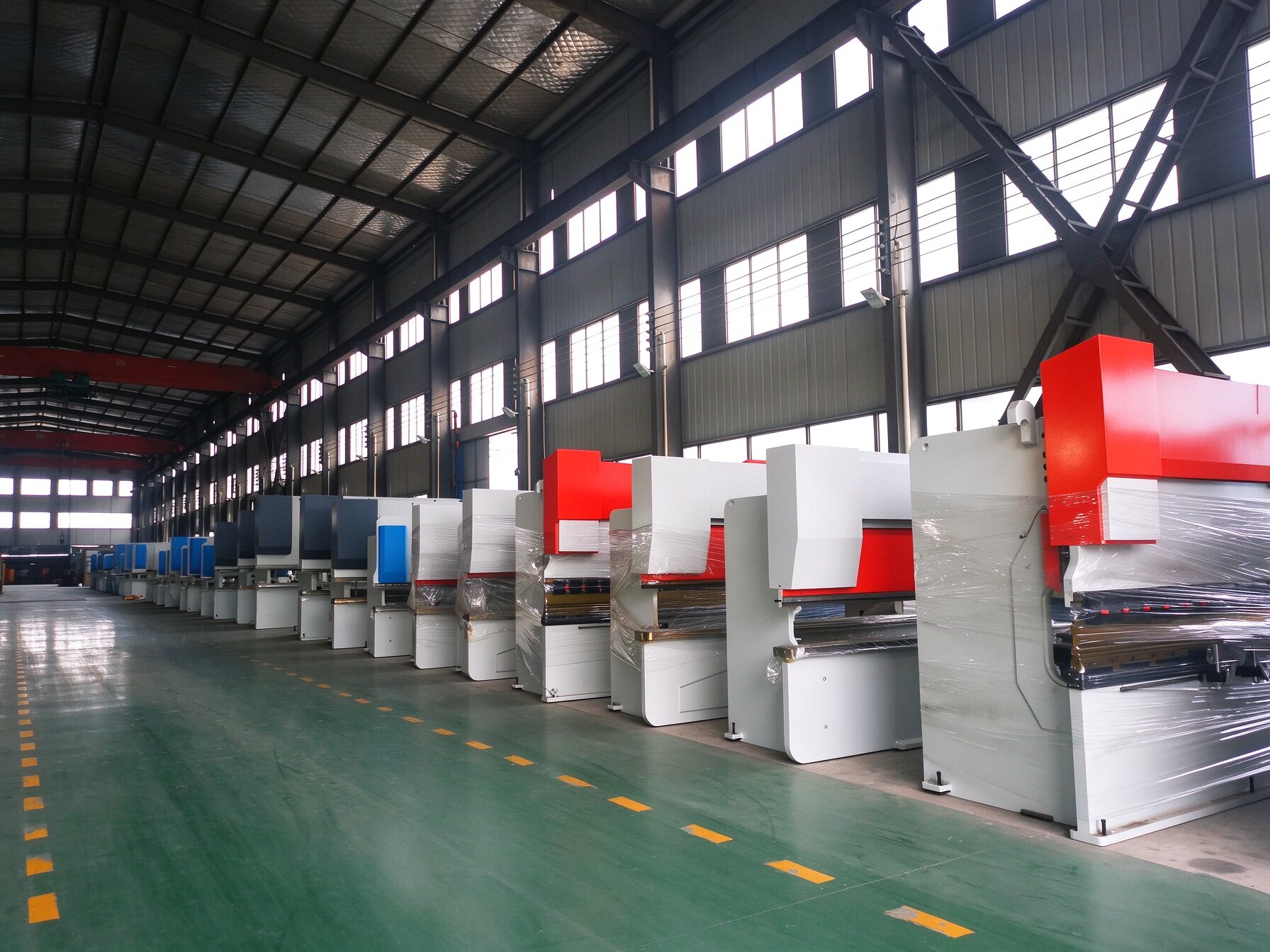
Finding the right press brake machine is essential for any sheet metal fabrication business. Choosing the wrong equipment can lead to inaccurate bends, production delays, and unnecessary costs.
At Shanghai MFG Machinery Equipment Co., Ltd, we help global clients select the ideal press brake for their exact projects. This guide breaks down the core selection process into simple, practical steps to help you make an informed decision.
Step 1: Define Your Bending Requirements (The Foundation)
Before looking at tonnage or price tags, gather three essential data points about your workpieces:
Maximum Bending Length: Your machine bed length should be your longest workpiece plus 100∼200 mm extra clearance. (For example, if your longest part is 3000 mm, choose a 3200 mm bed).
Maximum Sheet Thickness & Material: Common materials include carbon steel, stainless steel, and aluminum. Note: Stainless steel requires roughly 1.6×1.6\times1.6× to 2×2\times2× the bending force of carbon steel and has higher springback.
Precision, Complexity, and Volume: Are you performing simple 90-degree bends, or complex multi-step 3D sheet metal parts and enclosures?
Quick Tonnage Estimation Formula (Carbon Steel)
Bending Force (Tons) ≈ 8 × Plate Thickness (mm) × Bending Length (m)
Note: Multiply by 1.6–2 for stainless steel, and add a 20% safety margin. Avoid long-term single-point heavy bending in the center of the bed, as it permanently damages bed rigidity.
Step 2: Choose the Right Press Brake Type (Sync Technology)
The synchronization method determines the machine's precision, application range, and price point.
| Machine Type | Precision | Best Suited For | Pros & Cons |
| Torsion Bar Synchronized Press Brake | ±0.1∼0.2 mm | Simple sheet metal, single-angle bending, thick plates, budget-friendly projects, door frames. | Pros: Lower cost. Cons: Mechanical sync means poor eccentric load handling; large center deflection on long parts; usually no auto-crowning. |
| Electro-Hydraulic Servo Press Brake (Mainstream CNC) | ±0.02∼0.05 mm | Electrical enclosures, stainless steel, multi-step batch production, export precision sheet metal. | Pros: Independent dual-cylinder closed-loop control, optical scale feedback, handles eccentric loads well. Cons: Requires working table crowning; higher price than torsion bar. |
| All-Electric Servo Press Brake | ±0.01 mm | Thin precision parts, small components, clean rooms, oil-free environments. | Pros: Fast speed, energy-efficient, low noise. Cons: Lower maximum tonnage, unsuitable for very thick plates, highest cost. |
Export Recommendation: For overseas orders, stainless steel processing, and strict angle consistency, prioritize Electro-Hydraulic Servo Press Brakes.
Step 3: CNC System & Axis Configuration
Popular CNC Controllers
Delem (Netherlands - DA53T / DA58T): The world's most versatile controller, export-friendly, supports 3D graphical programming, with mature spare parts support (recommended for international trade).
Cybelec (Switzerland - CT12 / CT15): Excellent graphical programming capabilities.
ESA (Italy) & Domestic Systems: High cost-performance for local markets.
Backgauge Axes Selection
4+1 Axis (Y1/Y2 + X + R + Crowning): The most popular choice for export sheet metal work. Controls left/right cylinders (Y), front/back gauge depth (X), finger height (R), and table crowning.
6+1 Axis: Adds Z1/Z2 fingers for left/right retraction, ideal for complex multi-bend parts with protrusions.
Step 4: Core Components Check (Avoiding Common Pitfalls)
Machine Frame: Must be overall welded and treated with vibration stress relief annealing. Heavier frames of the same tonnage offer better rigidity. Frames without heat treatment will warp within months, causing angle drift.
Hydraulic Valves: Imported Rexroth or Hawe valves ensure top stability. Cost-effective domestic valves suit lighter duty cycles.
Crowning Compensation: Mandatory for long sheets (mechanical or hydraulic compensation). Without it, bending sheets over 3 meters long will cause the middle angle to open up.
Linear Optical Scales: Standard on electro-hydraulic machines to provide real-time closed-loop feedback on ram position.
Tooling & Clamping: Quick-clamps or hydraulic clamping systems paired with standard multi-V bottom dies ensure durability and precision.
Quick Recommendation Summary
Small shop, simple carbon steel, light usage, tight budget: Torsion bar CNC press brake.
Standard sheet metal batch production, stainless steel, export orders, multi-step bending: Electro-hydraulic servo 4+1 axis (Delem DA53T with crowning compensation).
Thin precision parts, clean room environment: All-Electric servo press brake.
Thick plates, heavy-duty long components: Prioritize higher tonnage, thickened frames, and robust crowning systems.
Need Help Finding the Right Machine?
Contact Shanghai MFG Machinery Equipment Co., Ltd today! Send us your maximum bending length, maximum plate thickness, material types, and target precision requirements, and our engineering team will provide a tailored machine model recommendation and a professional quotation ready for your business needs.
l Address: Buildings 1-4, No. 408 South Yunzao Road, Baoshan District, Shanghai
l Email: info@mfg-machinery.com
l Phone: 008615803802793
l Website: https://www.mfg-machinery.com/type/press-brake-machine
Contact us today to discuss your project requirements!