
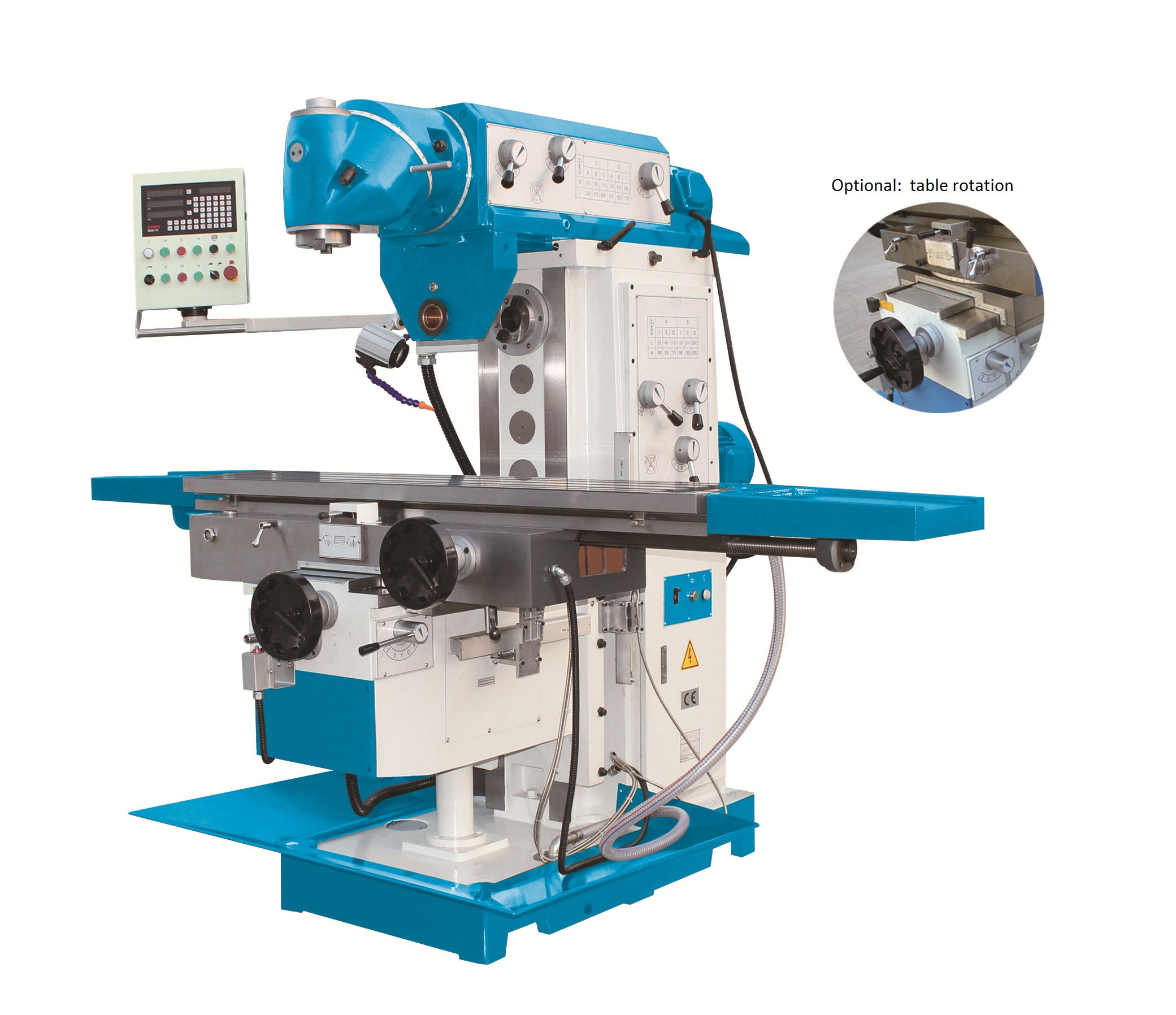
The Ultimate Guide to Buying a Conventional Milling Machine (Focus on Knee-Type X5032 & X6132 Models)
The Golden Rule: Define your workpiece first, choose the model second. Prioritize structural rigidity, accuracy verification, universal spare parts, and reliable after-sales support over the lowest price.
Step 1: Define Your Machining Requirements
Before making a purchase, clearly define these four parameters to avoid buying a machine that is either underpowered or oversized:
Maximum Workpiece Dimensions:
Length, width, and height determine the X, Y, and Z-axis travels. Always leave a 50 to 100 mm safety margin so the workpiece and fixtures don't hit the travel limits.
Material & Cutting Load:
Aluminum/Copper: Light cutting, high spindle speeds, standard rigidity requirements.
45# Steel, Stainless Steel, Quenched & Tempered Steel: Requires high rigidity and strong spindle torque. Prioritize thick castings and heat-treated models.
Accuracy Requirements:
Single-piece repair / Rough machining: 0.05class.
Molds / Mating parts: 0.02
High-precision parts: Conventional knee-type milling is not recommended; consider turret milling or CNC instead.
Primary Machining Operations:
Keyways, cavities, drilling, single-piece repairs: Vertical knee-type X5032 (the most versatile).
Long slots, shafts, spiral grooves, gears, heavy cutting with arbors: Universal horizontal X6132 (table swivels ±45°).
Core Classic Models:
X5032 (Vertical) and X6132 (Universal Horizontal). High market volume, easily accessible spare parts, and widely familiar to machinists. Ideal for beginners.
Step 2: Understand Machine Types
Vertical Knee-Type Milling Machine (X50 Series):
Spindle is vertical, making setup and observation easy. Compatible with end mills, keyway cutters, and drills. Most common in small-batch, mold, and repair workshops. Most milling heads can swivel to machine angled surfaces.
Universal Horizontal Knee-Type Milling Machine (X61 Series):
Spindle is horizontal, using arbors and support brackets for high rigidity. Great for large flat surfaces, long slots, spiral grooves, and splines. The universal table swivels for easy helical machining. Less intuitive for random, one-off odd jobs compared to vertical mills.
Turret Milling Machine (No. 4 / No. 5 Turret Mills):
Features a swiveling swivel head and ram, offering flexibility for small molds and toolrooms. Note: Not as rigid as the traditional X5032 for heavy steel roughing.
Step 3: Core Parameters & Rigidity Inspection
1) Castings & Aging Treatment (Ensures Long-Term Stability)
Beds, bases, tables, and sliding knees must be made of Meehanite or HT250 grade cast iron or higher, treated with artificial aging / secondary annealing to eliminate internal stress.
Inspection tip: Tap the machine body; a deep, solid sound indicates quality. Thin-walled, hollow-sounding castings will chatter heavily when cutting steel and lose accuracy over time.
2) Table, Travel & Load Capacity (Using X5032 as an Example)
Table size: Typically 1320mm \320mm\with standard T-slot spacing for easy use with vises, dividing heads, and standard fixtures.
Travel (X/Y/Z) & Max Load: Always ask for the rated load capacity rather than just paper specs. Overloading bends lead screws, causes stick-slip, and induces chatter.
Guide Ways: Dovetail hardened guide ways are standard on knee mills for heavy cutting. Look for induction-hardened, precision-scraped ways with forced lubrication.
3) Spindle System
Taper Hole: Mainstream ISO50 (7:24) for standard tooling. Avoid rare non-standard tapers.
Spindle Bearings: Prioritize P4/P5 precision bearings with a three-support structure. Radial runout at the tip of a 300mm test arbor should be ≤0.02mm
Motor Power & Speeds: Ensure adequate low-speed torque for heavy steel cutting.
4) Feed System
Gear-driven feeds are durable and prevent slip under heavy loads. Check for smooth rapid traverse and gear shifting without backlash or jumping.
Step 4: Quick Selection Reference Table
| Requirement Scenario | Recommended Model | Key Focus Areas |
|---|---|---|
| Single-piece repair, molds, keyways, boring, general job-shop work | X5032 (Vertical Knee Mill) | Casting aging, spindle runout, rigidity |
| Shafts, long through-slots, spiral grooves, gears, heavy arbors | X6132 (Universal Horizontal Mill) | Arbor support rigidity, table swivel accuracy |
| Small molds, toolrooms, limited space, flexible angle adjustments | No. 4 / No. 5 Turret Mill | Suitable for light-to-medium cutting; avoid heavy steel hogging |
Step 5: Procurement Anti-Trap Checklist
Avoid custom non-standard variations; stick to standard X5032 / X6132 models.
Insist on HT250 castings + aging treatment; reject weight-reduced, thin-walled frames.
Specify ISO50 standard spindle taper and P4/P5 bearings with agreed test arbor runout limits.
Require an factory accuracy inspection sheet, 72hours idling, and a trial cut before releasing final payment.
Verify that gears, friction plates, bearings, and toolholders are universally available on the open market.
Contact Us
Ready to select the right conventional milling machine for your operation?
Contact our expert team at Shanghai MFG Machinery Equipment Co., Ltd. for professional technical advice and custom configurations.
Website: https://www.mfg-machinery.com/
Email: info@mfg-machinery.com
Phone:+86 187 5562 7950