
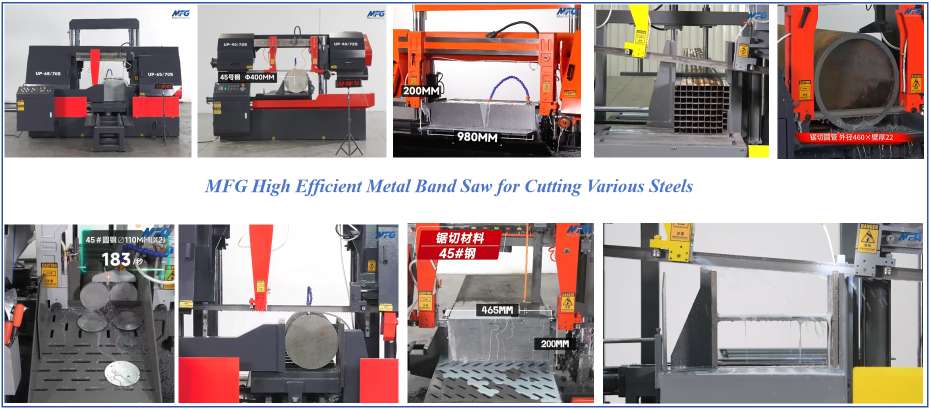
Steel structure factories often need to cut hundreds of parts with the same length. If workers measure, feed, clamp, cut, and count every part by hand, much of the shift is spent handling material instead of cutting it.
An automatic feeding band saw can move the material to a set length and repeat the cycle without manual measuring. Bundle cutting allows several bars, tubes, or profiles to be cut in one cycle. When the material is suitable and clamped correctly, these two functions can reduce handling time and make batch production easier to manage.
Where Does the Working Time Go?
A steel structure order may include columns, frames, supports, bridge parts, guardrails, and other welded sections. Before welding and drilling, raw material must be cut into planned lengths.
The cut itself is only one part of the job. Workers also need to:
- Load long material onto the roller table
- Measure and mark each cut
- Move the material into position
- Clamp and release the vise
- Count finished pieces
- Remove short parts from the discharge side
- Check the length during the batch
For a small order, manual work may be acceptable. For a batch of several hundred identical parts, these repeated actions take a large amount of labor time.
The problem becomes more obvious when the workshop cuts small tubes, narrow profiles, or round bars one piece at a time. The saw may have enough cutting capacity for several pieces, but most of that capacity is left unused.
How Automatic Feeding Changes the Process
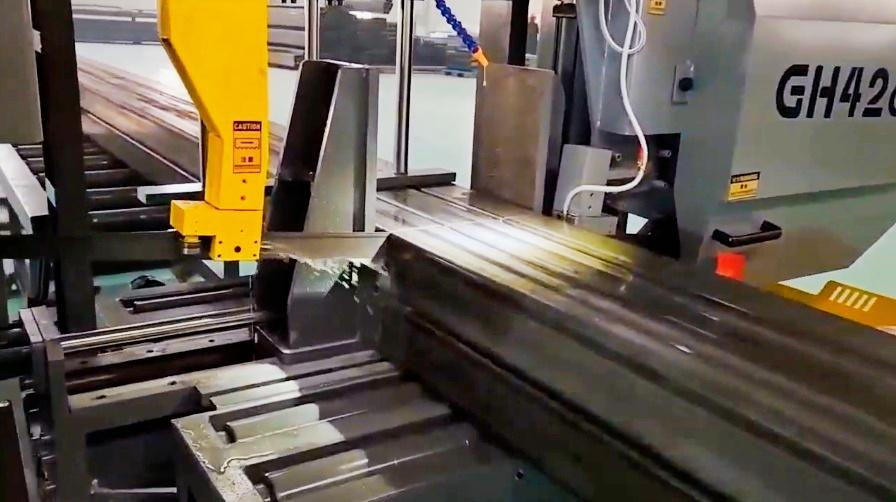
An automatic feeding system uses a feeding vise to hold the material and move it by a set distance. After the cut, the machine feeds the next length and starts another cycle.
The operator normally enters:
- Required cut length
- Number of pieces
- Blade speed
- Feed rate
- Number of feeding strokes, if the cut is longer than one stroke
Once the first parts have been checked, the machine can continue the batch with less operator input. The worker can prepare the next material load, inspect finished parts, or manage another task nearby.
Automatic feeding is especially useful for repeat jobs. It removes the need to mark every part by hand and reduces reading errors from tape measures.
However, feeding accuracy still depends on correct material support and clamping. Long bars should remain level with the machine bed. Chips and scale should not be allowed to build up on the vise surface.
What Is Bundle Cutting?
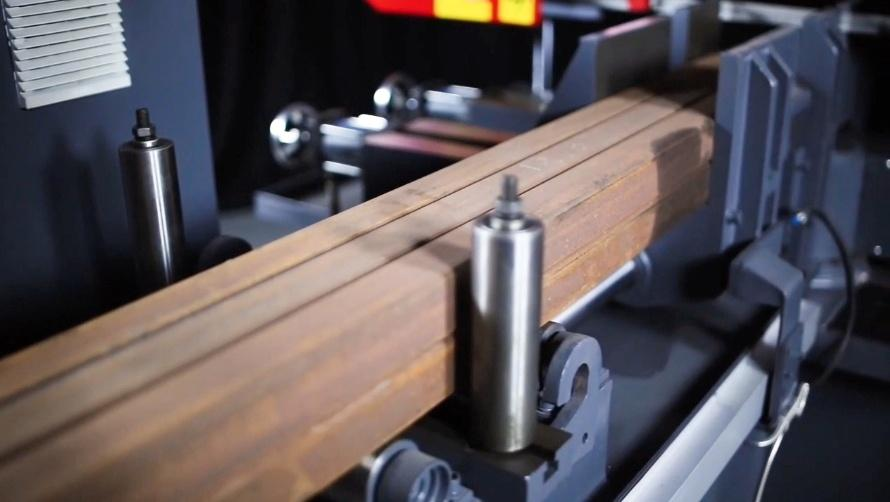
Bundle cutting means placing several pieces of material together and cutting them in one cycle. It is commonly used for:
- Round steel bars
- Square and rectangular tubes
- Small structural profiles
- Flat bars
- Repeated parts with the same length
Bundle cutting is not simply a matter of filling the cutting area. Every piece must remain stable while the blade passes through the bundle.
A machine prepared for this work often uses both side clamping and top clamping. The side vise holds the bundle across its width, while the top clamp stops upper pieces from lifting or moving.
For more information about metal cutting equipment used in batch production, visit the MFG Machinery website.
Single-Piece Cutting vs. Bundle Cutting
| Production point | Single-piece cutting | Bundle cutting |
|---|---|---|
| Parts cut in one cycle | One | Several |
| Material loading | Frequent | Less frequent |
| Clamping requirement | Standard side clamping | Side and top clamping are often needed |
| Operator attention | Higher for large batches | Lower after the bundle is set correctly |
| Best use | Large sections or mixed lengths | Repeated small and medium sections |
| Main risk | Slow batch output | Material movement inside the bundle |
| Setup time | Short | More time needed to arrange the bundle |
| Length control | Simple | Requires firm and even clamping |
Bundle cutting is most effective when the order contains many parts of the same material and length. It is less useful for mixed sizes or small orders where bundle preparation takes longer than the time saved.
Quick Troubleshooting Guide
| Problem | Likely reason | First check |
|---|---|---|
| Some pieces are longer than others | Material moved during feeding | Feeding vise pressure and roller support |
| Tubes turn inside the bundle | Top clamp pressure is too low | Top clamp position and bundle arrangement |
| Blade teeth break | Loose material or unsuitable tooth pitch | Clamping and blade tooth selection |
| Cut face is not square | Feed rate is too high or guides are worn | Feed setting and blade guides |
| Bundle separates near the end of the cut | Poor stacking or weak clamping | Bundle shape and top clamp contact |
| Automatic cycle stops | Sensor does not detect the correct position | Feed limit, vise, and material position |
| Chips build up between profiles | Weak chip brush or coolant flow | Wire brush and coolant nozzles |
A trial bundle should always be checked before a long run. Measure pieces from the top, middle, and bottom of the bundle. This shows whether the whole group remained stable during cutting.
A Practical Example from a Steel Structure Shop
Consider an order for 600 short square-tube braces.
With single-piece cutting, the operator must complete 600 feeding and clamping cycles. If six tubes can be placed in a stable bundle, the number of cutting cycles falls to about 100.
The actual time saved depends on tube size, wall thickness, cut length, blade choice, and loading method. Bundle preparation also takes time. Even so, the operator handles far fewer cycles and does not need to measure every part separately.
This is where automatic feeding and bundle cutting work well together: the bundle reduces the number of cuts, while automatic feeding controls the repeated length.
Market Insight: Infrastructure Orders Favor Repeatable Production
Infrastructure projects often require large numbers of similar steel parts. Delivery dates can be tight, but adding more operators is not always easy.
For this reason, steel structure factories are paying more attention to the complete cutting process. Buyers are looking beyond maximum cutting size and asking practical questions:
- Can the machine hold a bundle securely?
- Can it feed long material without slipping?
- How quickly can a new batch length be set?
- Can the operator check piece count on the control panel?
- Is the roller table suitable for the material weight?
- Can chips be cleaned without a long stop?
These questions have a direct effect on daily production. A large cutting range means little if material loading, measuring, or clamping still slows down every cycle.
Before Choosing a Bundle Cutting Band Saw
Send the machine supplier clear production information:
- Material type and grade
- Section shape and wall thickness
- Minimum and maximum size
- Number of pieces in one order
- Required cut length and tolerance
- Planned bundle arrangement
- Maximum material weight
- Available loading and discharge space
A cutting test with the real material is useful when the profile is thin, easy to deform, or difficult to stack. The correct machine size, clamp design, blade, and feed settings can then be selected from actual cutting conditions.
Automatic feeding and bundle cutting do not remove every manual task. They reduce repeated measuring, positioning, and single-piece handling. For steel structure factories processing repeat infrastructure orders, that can free a large part of the operator’s working time.
For questions about automatic feeding or bundle cutting applications, contact MFG Machinery:
Email: info@mfg-machinery.com
Tell/WA: +86 175 2133 1995