
The Bottom Line First: There is no absolute "best" design. The right choice depends entirely on your cutting diameter, material type, and long-term machine stability requirements.
1. Structure & Design Principle
Horizontal Cutting (Horizontal Guideway): The saw head moves forward and backward along a horizontal straight guide. The head's gravity pushes straight down onto the guideway, cutting horizontally into the material.
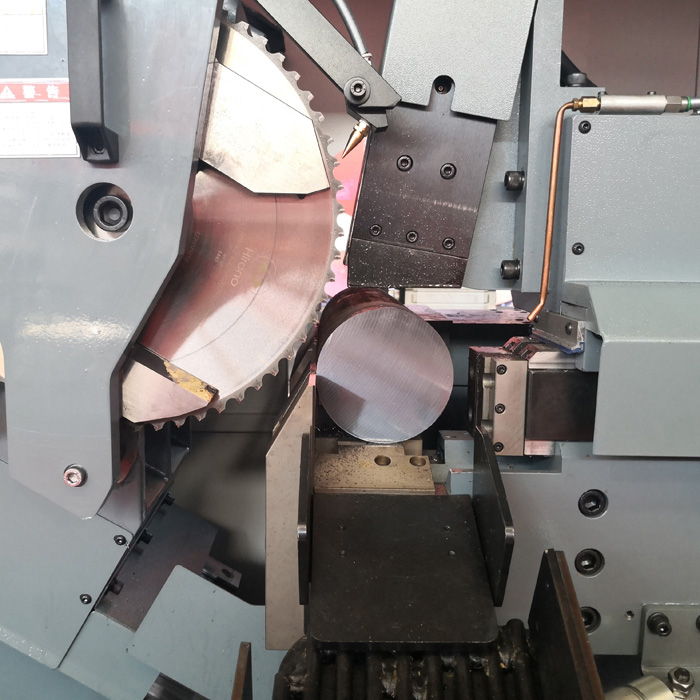
Inclined Cutting (Inclined Bed Guideway): The guideway is tilted at an angle of roughly 25° to 35°. The saw head slides down along this slope to cut into the workpiece.
2. Detailed Pros & Cons Comparison
�� Inclined Cutting (Miter Style)
✅ Pros:
Natural Chip Removal: Metal chips slide down easily along the slope, preventing buildup near clamps and guides for easy cleaning.
Lower Cutting Resistance: The saw blade makes gradual contact with the material, reducing shock. Ideal for small tubes and solid bars (under φ120mm) with lower blade wear.
Compact Footprint: Slightly more compact machine body, making it popular for small and medium models (sizes 60/70/80/100).
Lower cutting noise levels.
❌ Cons:
Ball Screw Strain: Gravity pulls the heavy saw head downward along the slope, constantly pulling on the ball screw. Heavy-duty solid cutting causes faster wear on screws and sliders.
Rigidity Limits: Weaker rigidity for heavy solid materials (over φ130mm), prone to slight vibrations. Long-term end-face squareness stability is lower than horizontal cutting.
Prone to feed gaps over long-term heavy-duty use.
Best Suited For: Round bars under φ120mm, copper/aluminum bars, thin-walled tubes, small batch parts, non-ferrous metals, and light-duty carbon steel cutting.
�� Horizontal Cutting
✅ Pros:
Balanced Force Distribution: The saw head weight is fully carried by the guideway. The ball screw only handles horizontal pushing and pulling, ensuring a longer lifespan for screws and guides.
High Rigidity & Anti-Vibration: The top choice for large-diameter solid round steel, 45# steel, chrome-molybdenum alloy steel, and thick-walled bars.
Superior Long-Term Precision: Maintains stable end-face verticality during high-volume, heavy-duty continuous production.
Widely used in heavy-duty large models (sizes 120, 160, 180, 220).
❌ Cons:
Chip Accumulation: Chips easily fall onto the horizontal guide surface, requiring regular air blowing and maintenance to prevent scratching.
Slightly larger machine size and higher initial investment cost compared to inclined cutting models.
Best Suited For: Solid bars over φ130mm, alloy steel, thick-walled round steel, forged blanks, 24/7 heavy-duty continuous mass production, and strict requirements for cutting verticality.
3. Quick Selection Guide
| Machine Type / Structure | Pictures | Best Cutting Diameter | Ideal Material Types | Production Scenario & Strengths |
| Horizontal Cutting | 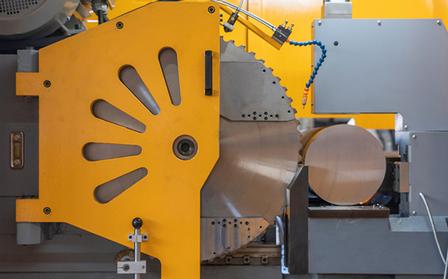 |
Max Diameter ≥ φ130mm | Solid hard bars, alloy steel, thick-walled steel, 45# steel, forged blanks | 24/7 heavy-duty mass production, strict end-face verticality requirements, high long-term stability and durability. |
| Inclined Cutting (Miter Style) | |
Max Diameter ≤ φ120mm | Aluminum, copper, thin-walled tubes, small profiles, light carbon steel | Small to medium batches, non-ferrous metals, frequent cleaning ease, lower cutting shock on smaller parts. |
4. Common Misconceptions Clarified
❌ Myth 1: Inclined cutting cuts faster.
Fact: Speed depends on spindle power, saw blades, and feed parameters. Under the same configuration, the speed difference is minimal.
❌ Myth 2: Inclined cutting has poor precision, and horizontal cutting has fewer burrs.
Fact: New machines meet precision standards out of the box. The real difference shows after thousands of hours of long-term stability.
❌ Myth 3: Inclined cutting cannot cut large materials.
Fact: Large inclined machines exist, but long-term heavy-duty wear is significantly higher than horizontal models of the same size.
About MFG Company & Cutting Solutions
At our company, we specialize in advanced metal cutting solutions, offering a comprehensive lineup of both high-speed horizontal cutting and inclined cutting circular saw machines. Whether you are cutting thin aluminum tubes or heavy-duty alloy steel bars, our engineering team can help you select the ideal machine configuration to maximize productivity, ensure cutting accuracy, and lower operating costs.
Contact our engineering team:info@mfg-machinery.com today for a free capacity analysis!