
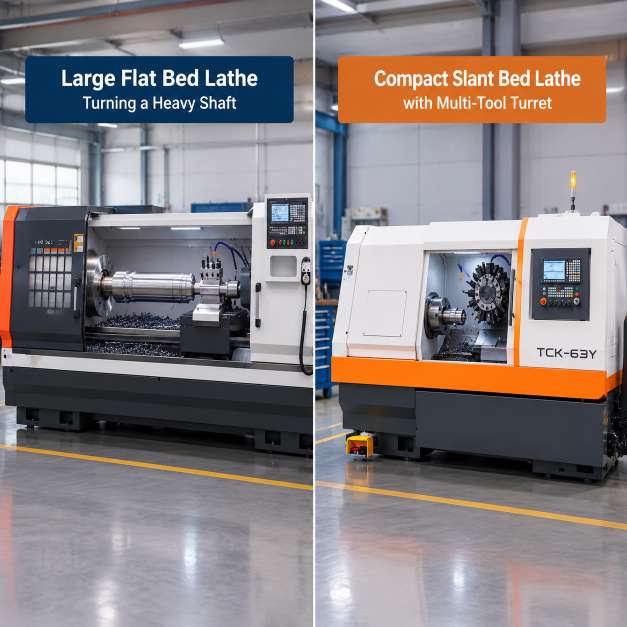
A slant bed CNC lathe often costs 30% to 50% more than a flat bed model. If your shop repairs heavy shafts, cuts oversized flanges, or runs single-piece batches, save your budget and buy a flat bed. If you run continuous production, use robotic loaders, or struggle with hot chips packing around the cutting tool, a slant bed pays for itself in tool speed and chip clearance.
The Economics of the 30% Price Gap
Many buyers hesitate when they see the price difference between the two frame types. The extra cost of a slant bed comes from the complex, one-piece angled casting and the heavy-duty linear or box ways designed for rapid movement.
However, you do not always need that speed. If you are machining long pipes, oil field equipment, or heavy hydraulic cylinders, raw swing capacity matters more than split-second tool changes. A standard flat bed CNC horizontal lathe gives you a massive working envelope, deep roughing rigidity, and easy manual loading access at a fraction of the cost.
Gravity, Chip Flow, and Cycle Times
The real limit of a flat bed in high-volume work is chip packing. When turning steel at high speeds, hot chips pile up on the horizontal rails. This traps heat against the machine frame, leading to thermal distortion and shifting part tolerances.
A slant bed CNC horizontal lathe (usually built at 30, 45, or 60 degrees) uses gravity to its advantage. Chips and coolant wash straight down into the conveyor, keeping the ways clean and cold. The angled layout also allows the cutting tool to sit closer to the operator while keeping the X-axis ball screw safely hidden behind the guards.

Quick Selection Matrix
Use this breakdown to match the machine frame to your daily work:
| Shop Requirement | Flat Bed CNC Lathe | Slant Bed CNC Lathe |
|---|---|---|
| Typical Batch Size | Single pieces or small runs | High volume, continuous shifts |
| Workpiece Type | Long shafts, heavy discs, odd shapes | Standardized parts, bar stock |
| Tool Changing | Slower (4-way electric tool post) | Very fast (8 to 12-station servo turret) |
| Chip Management | Manual clean-up often required | Excellent gravity chip removal |
| Automation | Difficult to fit robotic arms | Easy integration with bar feeders and robots |
Market Insight: Floor Space and Automation
Job shops are realizing that machine footprint is a fixed cost. A slant bed lathe takes up less floor space for the same cutting diameter because the X-axis is tucked away at an angle. For shops moving toward automated cells, the slant bed's compact front access makes it the standard choice for robot loading. But for custom repair shops, the wide-open table of a flat bed remains the most practical and profitable investment.
Send Us Your Print Before You Buy
Do not guess which frame type you need. Send us your maximum turning diameter, part length, and daily production target. We will tell you exactly which bed structure matches your cutting load and budget.
- Email: info@mfg-machinery.com
- Tell/WA: +86 175 2133 1995