
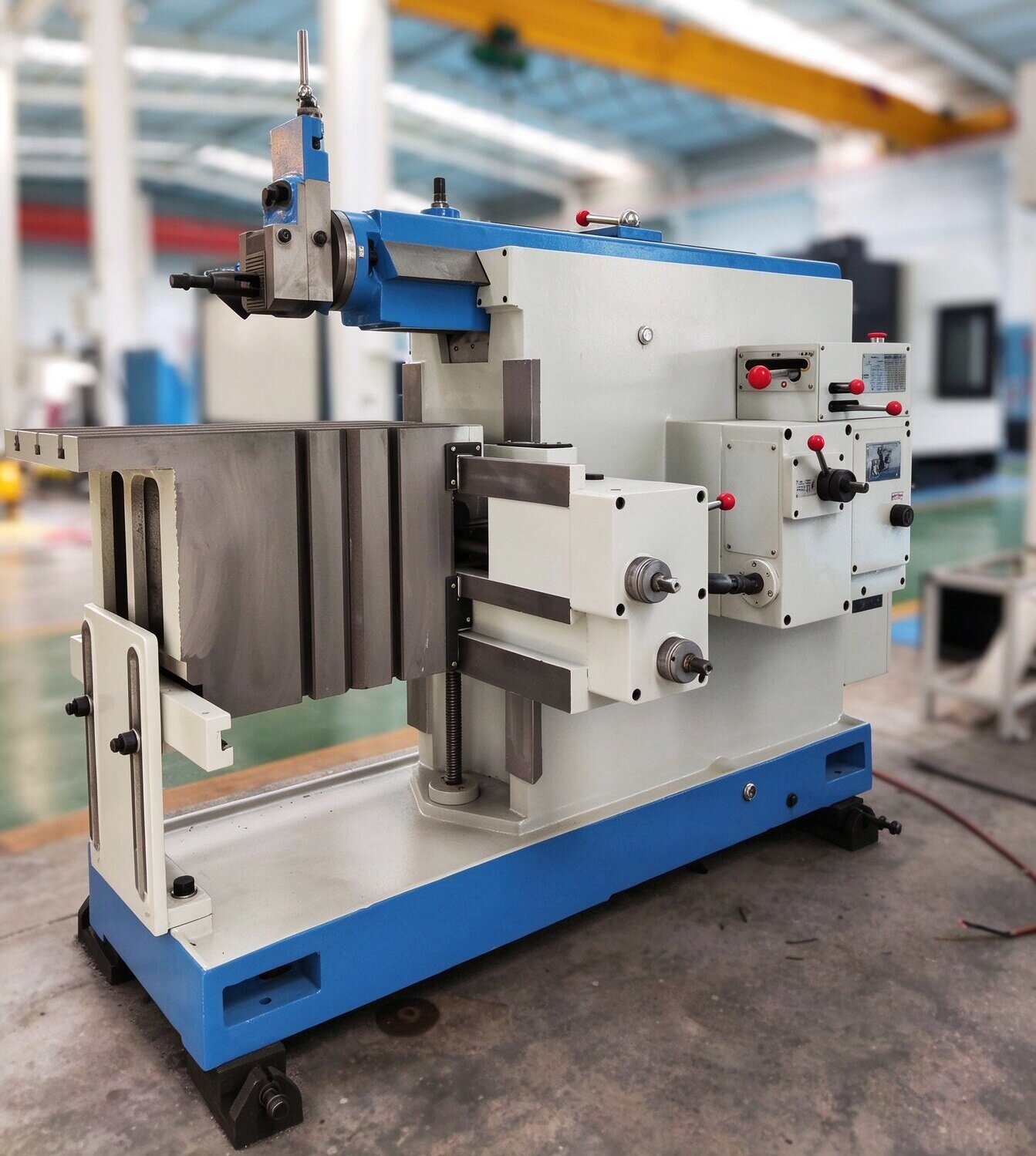
When machining hard materials like cast iron and stainless steel, machine shops often face annoying problems like chatter, vibration marks, and broken tool edges. While high-speed milling machines often struggle with high-frequency vibrations on tough metals, the traditional shaper machine offers exceptional stability.
Thanks to its heavy-duty rigidity and low-speed linear cutting style, a shaper machine practically eliminates structural chatter. It is a reliable and cost-effective solution for both rough and finish machining of hard or scaly workpieces.
At Shanghai MFG Machinery Equipment Co., Ltd, we provide top-tier industrial machinery built for high performance and reliability. If you have questions about heavy-duty cutting, feel free to reach out to us at info@mfg-machinery.com or call us at 008617321191875. Visit our website at https://www.mfg-machinery.com/type/shaper-machine to explore our full product lineup.
1. Heavy-Duty Rigidity Built for Vibration Resistance
The secret to a 's anti-vibration performance lies in its solid physical build:
High-Grade Cast Iron Body: Core parts are made of HT300 high-strength cast iron cast in one piece, combined with a heavy bed and closed dovetail guideways.
Stress Relieving Treatment: Parts go through vibration aging, secondary tempering, and high-frequency guideway quenching to prevent long-term deformation.
Short Force Paths: With a heavy net weight and short force paths, hydraulic shaper models deliver smooth, stepless cutting with minimal reversal impact. This easily absorbs the rebound stress of hard metals and prevents machine resonance.
2. Low-Speed Linear Cutting: The Natural Enemy of Chatter
Chatter is usually caused by high-speed rotation, large stress fluctuations, and weak system rigidity. Shaper machines avoid this through a simple mechanical advantage:
No High-Frequency Vibration Source: Shapers use a low-speed, linear reciprocating cutting motion.
Stable Cutting Forces: The tool holder and worktable lock tightly together, keeping the cutting force in a fixed direction.
Handles Complex Conditions Easily: Whether cutting intermittent surfaces, rough casting skins, or uneven material hardness, the shaper feeds smoothly without micro-shaking, tool deflection, or edge biting.
3. Material Performance Comparison: Cast Iron vs. Stainless Steel
To better understand how shaper machines handle tough materials, look at the comparison table below:
| Material Type | Core Machining Challenges | Shaper Machine Performance | Chatter Status | Final Quality & Results |
| Cast Iron & Cast Steel | Hard surface skin, hard spots, uneven hardness, heavy intermittent cutting impact (milling machines easily chip tools). | High heavy-duty rigidity, cuts straight through hard skin, cutting impact is absorbed by the heavy frame, steady feeding. | No structural chatter; minor shaking only occurs if clamping is loose. | Flat surfaces, no edge chipping, high size consistency. |
| 304 / 316 Stainless Steel | High toughness, strong spring-back, work-hardening, high-speed cutting causes sticky edges and wavy patterns. | Low-speed cutting prevents hardening, linear cutting cancels out material spring-back, zero high-frequency vibration. | Zero chatter and zero vibration marks under standard parameters. | Uniform and clean surface, no tool marks, no stretching deformation. |
4. Real-World Case Studies
Case 1: Rough and Finish Machining of a Heavy Cast Steel Base
The Problem: A heavy machinery factory struggled with a cast steel base covered in thick casting skin and sand inclusions. Using a vertical milling machine caused heavy chatter and broken tools whenever the cut was deep, resulting in a pass rate of under 70%.
The Shaper Solution: The factory switched to a hydraulic shaper machine. Leveraging its heavy-duty rigidity and low-speed cutting, it removed the allowance directly through the hard skin without pre-grinding.
The Result: The machine ran smoothly with zero vibration. Flatness error stayed within 0.02mm after finishing, efficiency increased by 30%, and the product pass rate reached 100%.
Case 2: Precision Planing of 304 Stainless Steel Thick Plates
The Problem: Processing thick 304 stainless steel plates caused heavy spring-back and regular wavy vibration marks, requiring heavy manual polishing.
The Shaper Solution: The shop used a shaper machine with a low, steady cutting speed and a dedicated carbide shaping tool.
The Result: The machine's high rigidity absorbed the spring-back stress. The finished plates came out clean and uniform with zero chatter marks, perfectly meeting precision assembly standards.
5. What Causes Minor Shaking? (And How to Fix It)
Rare instances of minor shaking during shaping are usually not caused by machine weakness. Instead, they come from human or setup errors:
Loose workpiece clamping or unsupported overhangs.
Insufficient tool rigidity.
Overloaded cutting parameters.
Solution: Simply reinforce the workpiece clamping, use high-quality carbide shaping tools, and set reasonable cutting depths and feed rates to eliminate vibration entirely.
Conclusion
Shaper machines offer solid rigidity and exceptional anti-vibration performance. For heavy-duty cutting of cast iron and stainless steel, they provide a stable, low-deformation, and high-tolerance solution that remains vital for heavy industry, mold making, and non-standard parts manufacturing.
Contact Us
Looking for reliable industrial equipment? Get in touch with us today:
Company Name: Shanghai MFG Machinery Equipment Co., Ltd
Address: Buildings 1-4, No. 408 South Yunzao Road, Baoshan District, Shanghai
Email: info@mfg-machinery.com
Phone: 008615803802793